Policy Feature: How the Dietary Guidelines for Americans Shape Food and Nutrition Programs
Improving the nutrition and diet quality in the United States is critical to the health and well-being of Americans, and the Dietary Guidelines for Americans play an important role now and for the decades to come. This special feature section explores the history and importance of the Dietary Guidelines for Americans—how they act not only as a model for individuals to follow as they make dietary decisions for themselves and their families, but also as a foundation for standards for federal food and nutrition programs that reach millions of Americans every year.
The section concludes by looking forward on ways to maximize the impact of the Dietary Guidelines for Americans on nutrition and diet quality, including: assuring the recommendations follow scientific evidence and independent expertise; providing schools and nutrition programs with sufficient resources for implementation; ensuring healthy foods are available, affordable, and accessible so all Americans are able to follow the recommendations; and implementing additional nutrition education and awareness campaigns for individuals and families to understand how to eat a more nutritious diet.
This section has four subsections: (A) Purpose and History of Dietary Guidelines for Americans, (B) Dietary Guidelines for Americans, 2025–2030, (C) Implications for Food and Nutrition Programs, and (D) Considerations for Future Dietary Guidelines for Americans.
(A) Purpose and History of Dietary Guidelines for Americans
The U.S. Department of Agriculture (USDA) and U.S. Department of Health and Human Services (HHS) issued the inaugural Dietary Guidelines for Americans in February 1980. USDA and HHS have released new editions of the Dietary Guidelines every five years since then. The National Nutrition Monitoring and Related Research Act of 1990 codified the joint release by USDA and HHS of the Dietary Guidelines for Americans at least every five years.
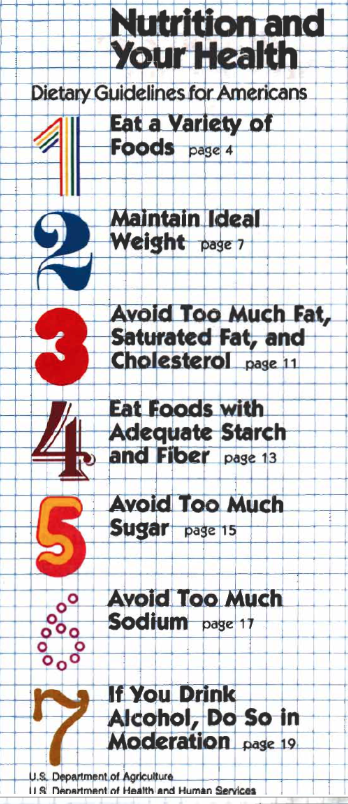 The first Dietary Guidelines for Americans from 1980 starts with the question: “What should you eat to stay healthy?” and its primary goal was to educate and aid Americans in making sound nutritional decisions at the individual level. It focused on seven overarching pieces of guidance on dietary patterns for healthy individuals.
Over the years, the Dietary Guidelines for Americans have expanded to include considerations across life stages. For the first time, the Dietary Guidelines for Americans, 2020–2025 included full recommendations for infanthood, toddlerhood, childhood, adolescence, adulthood, pregnancy, lactation, and older adulthood. The Dietary Guidelines have also incorporated visual aids for the public, including the Food Guide Pyramid (1992–2005), MyPyramid (2005–2011), MyPlate (2011–2025), and the New Food Pyramid (2026).
Since the beginning, the Dietary Guidelines for Americans have been centered on expert evaluation of available scientific evidence. The first issue of the Guidelines resulted from a two-year effort of the Joint Coordinating Committee, composed of scientists from the USDA and HHS who reviewed available scientific evidence on nutrition, diet, and health, and translated it to guidance for the public. They were informed by the 1977 congressional report Dietary Goals for the United States (Second Edition), the 1979 Surgeon General report Healthy People: The Surgeon General’s Report on Health Promotion and Disease Prevention, and other evidence.
In 1983, USDA and HHS established an independent Dietary Guidelines Advisory Committee (DGAC) composed of nine nutrition experts, as directed by the Senate Appropriations Committee. The DGAC was tasked with evaluating scientific evidence, reviewing public comments, and advising USDA and HHS on how to update the Dietary Guidelines. The DGAC issued its 1985 Scientific Report with advice to USDA and HHS in April 1985. Since then, USDA and HHS have formed a new DGAC for each Dietary Guidelines update in line with the structure developed in 1985: an independent panel is created to evaluate scientific evidence, review public comments, and advise USDA and HHS through a comprehensive Scientific Report on recommendations for the next iteration of the Dietary Guidelines. The National Nutrition Monitoring Act of 1990 codified the DGAC as an advisory committee, with governance following the Federal Advisory Committee Act, which regulates federal advisory committee operations and processes to ensure balance and freedom from conflicts of interest.
Despite the longevity of the Dietary Guidelines for Americans, the International Food Information Council survey found that, in 2025, fewer than half (44 percent) of American adults reported that they know a lot or a fair amount about the Dietary Guidelines for Americans. This is similar to the 2021 survey (46 percent) and higher than the 2011 survey (32 percent). The latest survey found the top considerations around food purchases were taste, price, healthfulness, and convenience.
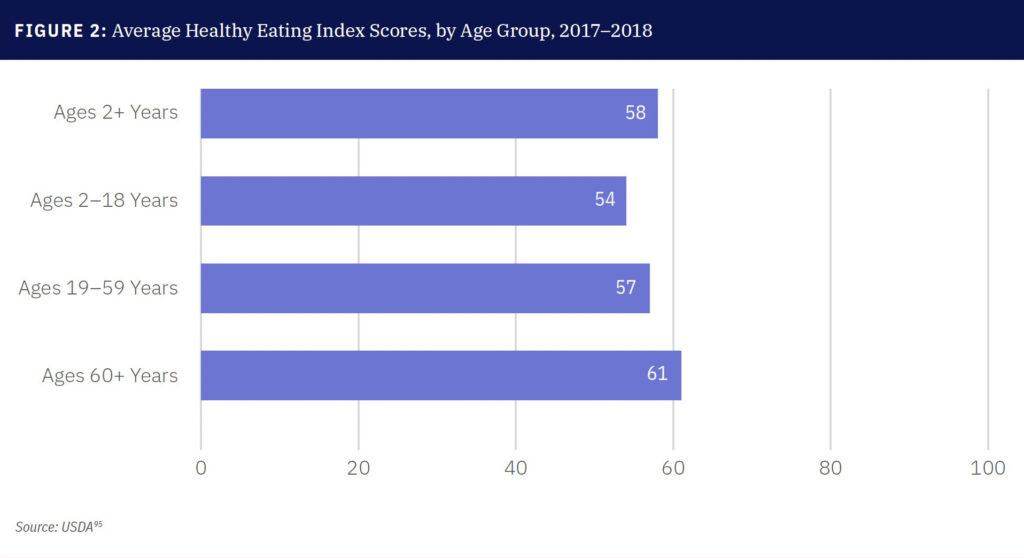
In fact, evidence shows that the Dietary Guidelines for Americans have had limited influence on consumer behavior and that most Americans do not meet the recommended guidelines. The most recent Healthy Eating Index—based on a 2017–2018 survey of dietary habits and an alignment with the 2020–2025 Dietary Guidelines—shows the average adult, ages 19 to 59, scoring 57 out of 100, which falls into the “needs improvement” category. (Note: Higher Healthy Eating Index scores correspond with better diet quality, with 100 being fully in line with recommendations. Scores above 80 are considered “good,” scores from 51 to 80 are considered “needs improvement,” and scores under 51 are considered “poor.”)
While the Dietary Guidelines for Americans may not be the primary consideration for most Americans when making dietary decisions, the recommendations are the foundation for food and benefits standards for federal programs, which serve millions of Americans each year. See subsection C for more on how the Dietary Guidelines for Americans affect food and nutrition programs.
(B) Dietary Guidelines for Americans, 2025–2030
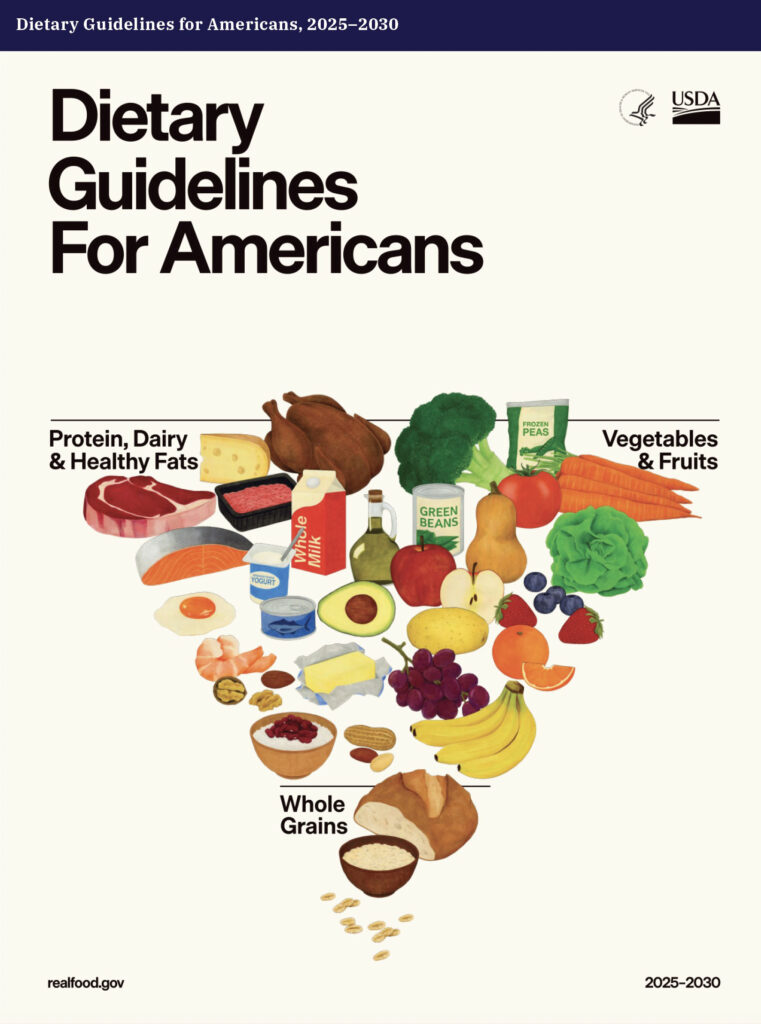 USDA and HHS released the most recent Dietary Guidelines for Americans, 2025–2030, in January 2026. Many of the 2025 recommendations are in line with the 2020 edition, including encouraging the consumption of fruits, vegetables, legumes, nuts, and whole grains, and limiting the consumption of saturated fat, added sugars, sodium, and sugar-sweetened beverages. Notable changes to the recommendations in 2025 include: (1) an increase in recommended protein intake; (2) the addition of red meat and full-fat dairy products as healthy protein and fat sources; (3) the elimination of prior recommendations to eat a variety of vegetables across defined subgroups (e.g., dark green; red and orange; beans, peas, and lentils; starchy); (4) a recommendation that children from birth through age 10 consume no added sugars (up from age 2 previously); and (5) a call to limit refined carbohydrates and “highly processed foods.” The new Guidelines were paired with a new visual aid called the “New Food Pyramid” and the slogan of “Eat Real Food.”
Nutrition experts and public health advocates offered mixed reviews of the Dietary Guidelines for Americans, 2025–2030. Some aspects, like the continued emphasis on consuming whole foods and limiting added sugar and sodium, met broad approval, while other aspects, like the new red meat endorsement and changes to vegetable recommendations, were met with concern by some. Specifically, the inclusion of whole-fat dairy and red meat has been criticized as being in tension with the recommended saturated fat limit and with long-standing evidence that red meat consumption increases the risk of cardiovascular disease and some cancers. The “New Food Pyramid” visual aid is another point of contention, as it elevates of meat and dairy products at the forefront and minimizes whole grains compared with the stated recommendations in the Guidelines.
Experts also were alarmed about the process behind the development of the 2025–2030 Guidelines as it diverged both from standard procedures and the findings of the 2025 Dietary Guidelines Advisory Committee’s Scientific Report. The DGAC issued the Scientific Report, in December 2024 for public comment with the intention to inform the 2025–2030 Guidelines. USDA and HHS then issued a separate supplemental scientific analysis called “The Scientific Foundation For The Dietary Guidelines for Americans” in conjunction with the release 2025–2030 Guidelines. The Trump Administration’s stated reason for the supplemental analysis was “to address and correct deficiencies identified in the Scientific Report, … which framed its analysis through a health equity lens.” Media reports and disclosures raise concerns about financial ties to the beef and dairy industries that the additional analysis’s subject-matter experts and review authors appear to hold. In the end, 14 of the DGAC Scientific Report’s 56 recommendations were accepted in full, 12 were partially accepted, and 30 were not implemented in the 2025–2030 Guidelines.
New editions of Dietary Guidelines for Americans should iterate with new evidence on healthy nutrition and dietary patterns—but changes should be grounded in evidence, away from industry or financial conflicts of interest, and driven by an independent DGAC and its recommendations put forth in the Scientific Report.
(C) Implications for Food and Nutrition Programs
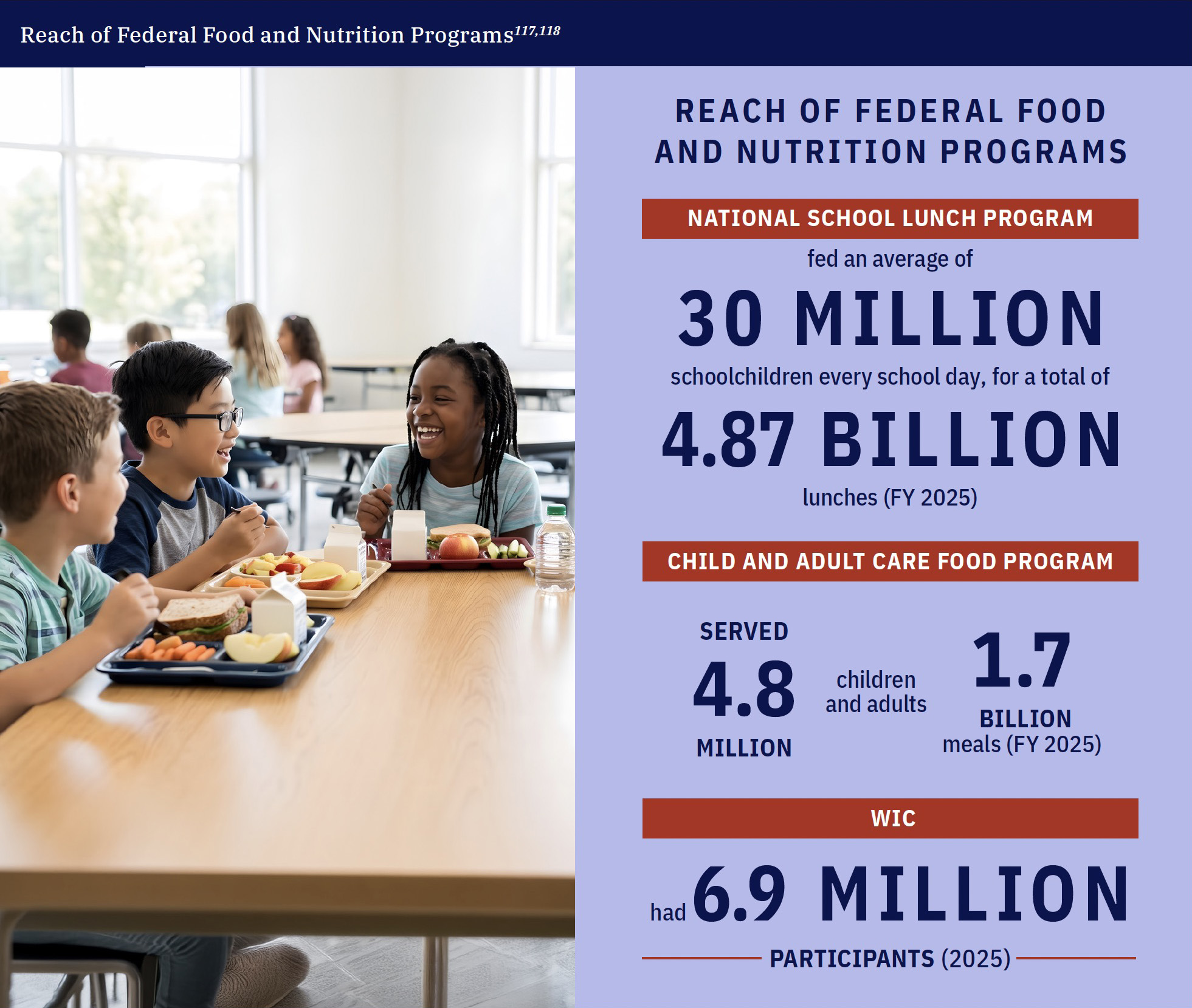
The Dietary Guidelines for Americans provide the scientific foundation for federal nutrition policies and standards that, in turn, shape nutrition programs across the country. These programs include the National School Lunch Program (NSLP), which fed an average of 30 million schoolchildren every school day for a total of 4.87 billion lunches in fiscal year (FY) 2025; the Special Supplemental Nutrition Program for Women, Infants, and Children (WIC), which had 6.9 million participants in 2023; and the Child and Adult Care Food Program (CACFP), which served a total of 4.8 million enrolled children and adults 1.7 billion meals in FY 2025.
 Periodically, since the National School Lunch Act of 1946, Congress has reauthorized and considered changes to child and other nutrition programs. The 1994 reauthorization law, the Healthy Meals for Healthy Americans Act, added the requirement that school meals follow the Dietary Guidelines for Americans. USDA guidance through the early 2000s took the form of voluntary recommendations for schools to align with the Dietary Guidelines.
The Healthy, Hunger-Free Kids Act of 2010, the most recent reauthorization bill, made major changes to school meal programs and other nutrition programs. The law expanded free school meal access in low-income areas (e.g., Community Eligibility Provision), increased schools’ reimbursement rate for lunches that meet nutrition standards, created new nutrition standards for snacks and beverages available in schools outside of the school meal programs (e.g., Smart Snacks in Schools), and strengthened nutrition standards for school meals programs and CACFP by requiring them to align with the 2010 Dietary Guidelines for Americans. USDA’s implementation of this law included rules to increase fruits, vegetables, and whole grains; to decrease sugar, saturated fat, and sodium; and to create maximum levels of calories per meal, with implementation occurring in phases from 2012 to 2023.
Separately, in 2007, USDA issued a rule overhauling the WIC food packages for the first time since 1980 and aligning them with the Dietary Guidelines for Americans. This new food package, with implementation by August 2009, added fruits, vegetables, and whole grain products as well as incentives to promote breastfeeding.
Together, these changes to nutrition standards in federal programs have improved meal quality, improved participant diet quality, and reduced childhood obesity rates among participants. For example, research finds that school meal nutrition requirements increased the nutritional quality of meals and reduced the prevalence of obesity among children in the program. After WIC nutritional requirements were strengthened, participant diet quality improved—including large increases in consumption of beans, greens, and whole grains—and obesity rates among children in the program declined.
Since the Healthy, Hunger-Free Kids Act of 2010 and 2007 WIC food package update, USDA has updated nutrition program standards through rulemaking to align with the concurrent Dietary Guidelines for Americans. The most recent nutrition standards revisions for WIC were in 2024. In April 2024, USDA finalized revisions to the WIC food packages to align with the 2020–2025 Guidelines, following a proposed rule issued in November 2022. The changes included several that would improve nutrition. For example, the rule increased fruit, vegetable, and whole grain benefits, shifted fruit juice benefits to whole fruit, and added more types of healthy foods to the package (e.g., seafood and more whole grain options).
The most recent overarching nutrition standards for school meal programs and CACFP also came in 2024. In April 2024, USDA issued a final rule updating nutrition standards for school meal programs and CACFP to align with the Dietary Guidelines for Americans, 2020–2025. Changes included new added sugar limits as a percentage of calories, total added sugar limits for certain items, and simplified sodium limits, with implementation to start with school year 2025–2026.
Other programs are also affected. For example, Dietary Guidelines for Americans inform community health center patient education, nutrition standards for Meals on Wheels and other congregate meal programs for older Americans, military and veteran meal services, the food and nutrition services at hospitals that accept Medicare, CDC’s Food Service Guidelines for Federal Facilities, the (SNAP-Ed) nutrition curriculum (before it was eliminated in the 2025 One Big Beautiful Bill Act), the maximum benefit value in SNAP, Nutrition Facts label design, and the definition of “healthy” for packaged food labels.
As of August 2026, USDA and HHS has not issued new overarching nutrition standards or guidance to align school meals, CACFP, WIC, or other nutrition programs with the 2025–2030 Dietary Guidelines, though they have indicated that they will soon and have started instituting targeted updates and voluntary recommendations.
- In February 2026, USDA issued a memo to child nutrition program directors stating that it was actively developing a proposed rule to update nutrition standards to align with the new Guidelines.
- In March 2026, the Centers for Medicare & Medicaid Services (CMS) released a memorandum outlining expected changes to hospital in-patient foods to align with the 2025–2030 Dietary Guidelines, including “Limiting ultra-processed food options for patients,” “Elimination of sugar-sweetened beverages unless clinically appropriate in limited scenarios,” and “Elimination of refined grains and replacing them with 100% whole grains.”
- In May 2026, USDA revised the 2024 standards to add whole- and reduced-fat milk options. USDA cited the 2025–2030 Dietary Guidelines recommendation of full-fat dairy and the Whole Milk for Healthy Kids Act of 2025 to support the update.
- In August 2026, USDA and HHS announced the Harvest to Hallways initiative that would increase investments for child nutrition programs—including funding for school cafeteria infrastructure and research on improving school meal nutrition—and called for greater state adoption of the optional Pledge for Healthier School Meals where USDA encourages “states and food service companies, with the support of school food authorities, to pledge to make school meals and snack programs healthier.” The pledge includes six specific recommendations that align with the 2025–2030 Dietary Guidelines: (1) Replace breakfast pastries with whole-food breakfast options; (2) prepare meat and meat alternates using healthy cooking methods; (3) serve 100% whole grain products; (4) improve smart snacks served in schools; (5) prioritize whole fruit; and (6) serve whole milk.
Many Dietary Guidelines for Americans, 2025–2030 recommendations are in line with previous Guidelines, though several of the key changes will be difficult to implement in real-world settings due to logistical and resource constraints. For example, reducing processed foods in schools and child and adult care settings requires additional resources, including staff time, kitchen equipment, and potentially major infrastructure renovation or construction, and ensuring no added sugars for children under age 11 may not be feasible as sugar is pervasive across many staple foods (e.g., bread, yogurt, condiments).
Sidebar: School Meals: Current and Future Resource Needs
(D) Considerations for Future Dietary Guidelines for Americans
Interview with Alexia Thex, President of the National CACFP Association
 Alexia Thex, M.Ed., is the president of the National CACFP Association (NCA) and leads the association’s strategic direction, guiding the advocacy efforts and organizational growth that advance the mission and interests of association members. She holds a Master’s of Education from the University of Texas at Austin.
TFAH: You serve as president of the NCA. Could you tell us about the organization, how its members inform its policy agenda, and—as NCA marks its 40th anniversary—one change in the food-policy environment or policy success that particularly stands out?
NCA is the leading national nonprofit organization that supports the CACFP community. We have almost 3,000 members. Our mission is to create professional development, resources about nutrition and the program, and then advocate to strengthen and increase access to the CACFP. We develop our policy priorities based on our members’ feedback, the board of directors elected by our membership, and the CACFP community at large. The CACFP wasn’t established until more than 20 years after the National School Lunch Act. Later, Congress expanded access to family child care homes, followed by for-profit child care and adult care. Afterschool meal sites and emergency shelters were only added in the late 1990s. Over that span of time, more people have had access to healthy meals and snacks. So, to me, the existence of the program is a policy win.
TFAH: What are you hearing from members about the most pressing nutrition and food-access challenges facing the children, families, and older adults they serve? How are those experiences shaping NCA’s advocacy?
The challenges differ somewhat by site type, but at the operational level, what we’re hearing is that food costs are super high. Staffing challenges also continue to affect providers, as recruiting and retaining staff is difficult when wages often do not align with the cost of living. Paperwork requirements continue to grow, and reimbursement has not kept pace with the real cost of preparing and serving meals. On the sponsor level—the organizations that take financial and administrative responsibility for the program—it’s similar: increased cost. Right now, fuel costs are high for the monitors who conduct site visits for the program. Over the last decade, more [child and adult care] providers are leaving the program, even though they’re eligible. That’s due to both increased costs and reimbursement not being enough to cover the cost of all the administrative burden in the program.
We have many advocacy priorities focused on reimbursement, such as eliminating the two-tier reimbursement system, adding reimbursement for an additional meal, and increasing reimbursement by 10 cents for every meal and snack. The child nutrition reauthorization hasn’t happened since 2010. It’s supposed to happen every five years. We’re delayed, but we have some amazing bipartisan champions in both the Senate and the House. I think everybody agrees that children should have nutritious meals and snacks, as well as older adults, it’s just moving it forward. We also prioritize addressing the administrative burden of the program. We know the amount of paperwork a provider needs to complete to put lunch on the table is pushing eligible providers off the program. When administrative requirements become to burdensome, providers have less time to devote to meal preparation, education, and care.
TFAH: It remains uncertain how USDA may align CACFP with the 2025–2030 Dietary Guidelines. How do providers typically implement new standards when they are issued? What are providers experiencing as they implement the current standards?
CACFP operators are child and adult caregivers first and foremost. Their priority is caring for children and older adults every day, and they work hard to provide nutritious meals alongside all of their other responsibilities. They are not necessarily nutritionists. They are not all food-service directors. If you think about the challenges we have communicating nutrition requirements or best practices to consumers, it’s the same in the CACFP. The good news is that they really care about the people that they care for and are eager to learn, but it takes repeated technical assistance. When federal changes happen, our team will immediately comb through the rule change to make sure we fully understand it. We then do listening sessions and train sponsors and site operators. We hear what else providers need and put together resources that simplify all the regulations into something that a consumer would understand.
We have a close relationship with USDA and regularly provide feedback and asking how we can better help implement all of these changes and maintain program integrity, We are eager to learn what the upcoming meal pattern updates will be but we don’t know what to expect. Everybody wants to eat real food, but it takes investment, time, and a lot of training. For example, questions remain about whether future changes to nutrition guidance could affect CACFP meal requirements, including protein and added sugar standards. Any new requirements in these areas could create operational challenges for child and adult care providers as they work to serve meals that meet program standards. Even with one provider who was really into nutrition, she was opening at 7:30 am, closing at 5:30 pm, and getting up at 5:30 in the morning to cook meals. That’s somebody working a 12-hour day, every day. And that’s not counting compliance paperwork. We want the meals to be as nutritious as possible, but that it’s going to require more reimbursement and a lot of technical assistance.
TFAH: To adopt new nutrition guidance, what technical assistance, time, or funding would organizations need to implement future changes successfully, including support or resources from policymakers at any level?
USDA SNACS-II study [Study of Nutrition and Activity in Child Care Settings], determined what it really cost centers to put meals on the table: $8.80 for breakfast, $9.70 for lunch, and $6.30 for snack. For centers, that is only 26 percent of the total cost of breakfast, 35 percent for lunch, and 21percent for snacks. Serving meals that emphasize whole foods, scratch cooking, and less added sugar often requires additional time, labor, and food costs. Repeated technical assistance is necessary and often continues long after the rule is finalized.
For example, while the recent milk flexibility rule was widely welcomed, sponsoring organizations and administrators continue to provide guidance and training on how the changes apply in practice. They receive no additional funding to support this work, even though it is critical to ensuring providers understand and comply with new requirements. Any change or additional rule increases the complexity of the program, requiring reinforcement to navigate the guidance correctly.
TFAH: What recent federal policy or administrative changes have improved the operating or food-service environment for CACFP providers? What additional federal actions would most help providers improve nutrition and serve participants effectively?
A recent policy success was the milk rule that just came out, allowing flexibility for whole milk, reduced fat, skim, and nonfat milk to all be served in the CACFP. That was a win on two fronts. One, on the nutrition side, a lot of operators have responded that they think that this will increase the consumption of milk. Two, it helps rural providers and people in food deserts, because providers are often given a program violation or their meals are disallowed and not reimbursed because they are serving the wrong milk. They’re not serving the wrong milk because they don’t know what the right milk is, they literally don’t have access to it and cannot find it in their area. If we look back in a year to this rule, you’ll probably see less findings and disallowances—and hopefully kids drinking more milk.
For improvements, policies to increase reimbursement is number one. Reducing the administrative burden is another. For providers, serving a reimbursable meal involves much more than simply putting food on the table. They often need to gather product documentation, verify meal pattern requirements, determine ounce equivalents, assess whether foods qualify as whole grain-rich, and maintain detailed menu records. That’s just for one meal. When you multiply those tasks across multiple meals and snacks every day, the paperwork adds up quickly. In our surveys, providers consistently cite the lack of sufficient reimbursement as a concern, but we also frequently hear that the administrative requirements can outweigh the financial benefit of participation. Reducing that burden would make the program more sustainable and accessible for providers.
TFAH: CACFP is federally funded and generally administered by state agencies, including agencies responsible for education, health, human services, aging, and agriculture. What trends have you observed in state policy and administrative decisions in response to recent federal policy changes? How are state responses helping participating organizations adapt or are they potentially creating additional challenges?
NCA maintains a close relationship with state agencies. They are a critical piece to the infrastructure of CACFP. The chain goes from USDA to the states down to the institutions, so they play an important role in the system. State agencies can further restrict federal guidelines, so even if a food is creditable by federal guidelines, a state might say you can only serve that three times a week, or you can’t serve it at all. We understand that states have to be responsive to their community’s unique circumstances and needs, and we are thankful for the work state agencies do to support the CACFP.
Governors and the state legislature can play a key role in supporting both CACFP providers and sponsoring organizations. For example, the USDA has had a waiver for the past several years that states can apply to do one off-site monitoring visit. It saves time, allows more time for technical assistance, and saves costs. Having that one visit is so great, especially for states where there’s very few sponsors and they’re trying to get 400 miles away or over the mountains, or maybe they have a weather issue. Some states are doing great work. Massachusetts does a lot of training and technical assistance, and in a time where family childcare homes are declining, it’s the only state where they are increasing. Washington, DC, has the extra 10-cent reimbursement in every meal and snack through the through the Healthy Tots Act. There’s a number of local food incentives in some states where they’re getting 5 cents reimbursed if a provider serves a local fruit or vegetable in a lunch or supper.
TFAH: CACFP operates in settings ranging from family childcare homes and childcare centers to after-school programs, emergency shelters, and adult day care. Are certain settings or populations facing distinct barriers to participating in or implementing the program? What changes would help eligible organizations join and remain in CACFP?
One of the challenges of the CACFP is that the program occurs in a large variety of sites. For family child care homes, especially for homes receiving the lower Tier II reimbursement rate, the provided reimbursement is just not enough. We also continue to see child care providers and schools that want to participate in the CACFP, but encounter barriers related to site eligibility. For example, a program may be licensed by a State agency to provide child care, yet still be unable to participate because it does not meet USDA’s definition of an eligible site type. In some cases, these requirements can prevent otherwise qualified providers from joining the program. Schools that are eligible for afterschool snack and supper face unique barriers as well, such as funding for afterschool programs, staff challenges, and student transportation challenges
TFAH: What are the one or two of the most important actions Congress, USDA, or state policymakers should take to strengthen CACFP and improve nutrition and food access for the people it serves? Is there anything you would like those policymakers to know about CACFP?
Two important opportunities for Congress are the Child Care Nutrition Enhancement Act and the Early Childhood Nutrition Improvement Act. Together, these bills would strengthen the CACFP by increasing reimbursement, addressing longstanding barriers to participation, streamlining program administration, and modernizing program operations.
Most importantly, they would make it easier for providers to participate in and sustain the program, helping more children gain access to nutritious meals and snacks they deserve.
CACFP might be the most unrecognized of the child nutrition programs and could make an even larger impact with greater investment, especially utilizing these experts, these childcare and adult care providers. There’s research out there that the most formative years for healthy outcomes are zero to five. If we wait until school age to start implementing some of these healthy habits, they’ve already spent five years forming their taste preferences, learning about what they’re supposed to eat. By definition, CACFP has a responsibility to teach the children in their care about the food they’re eating.
All the caregivers involved in the program engage in both nutrition education and agricultural education. They also address food, exercise, and screen time. Also, with so many children not being able to access SNAP now, providers are being asked to serve a little bit extra. It’s not uncommon to have double breakfast on Monday, or a little extra snack on Friday that they’re not being reimbursed for. I think changes to SNAP have exacerbated that. Some of our providers are on SNAP themselves while doing detailed work with families and older adults. We went to an adult care setting a few years back, and I don’t think people realize how much our providers do, like the amount of color-coded note cards for every individually modified meal. It’s amazing work. It’s kind of inspirational. And I wish more people knew about it.
Read more in the 2026 State of Obesity report.